
By Alan Varan
The Sasanian conquest of the upper Tigris and the last stand of the Arsacids in the mountains of Arzanene.
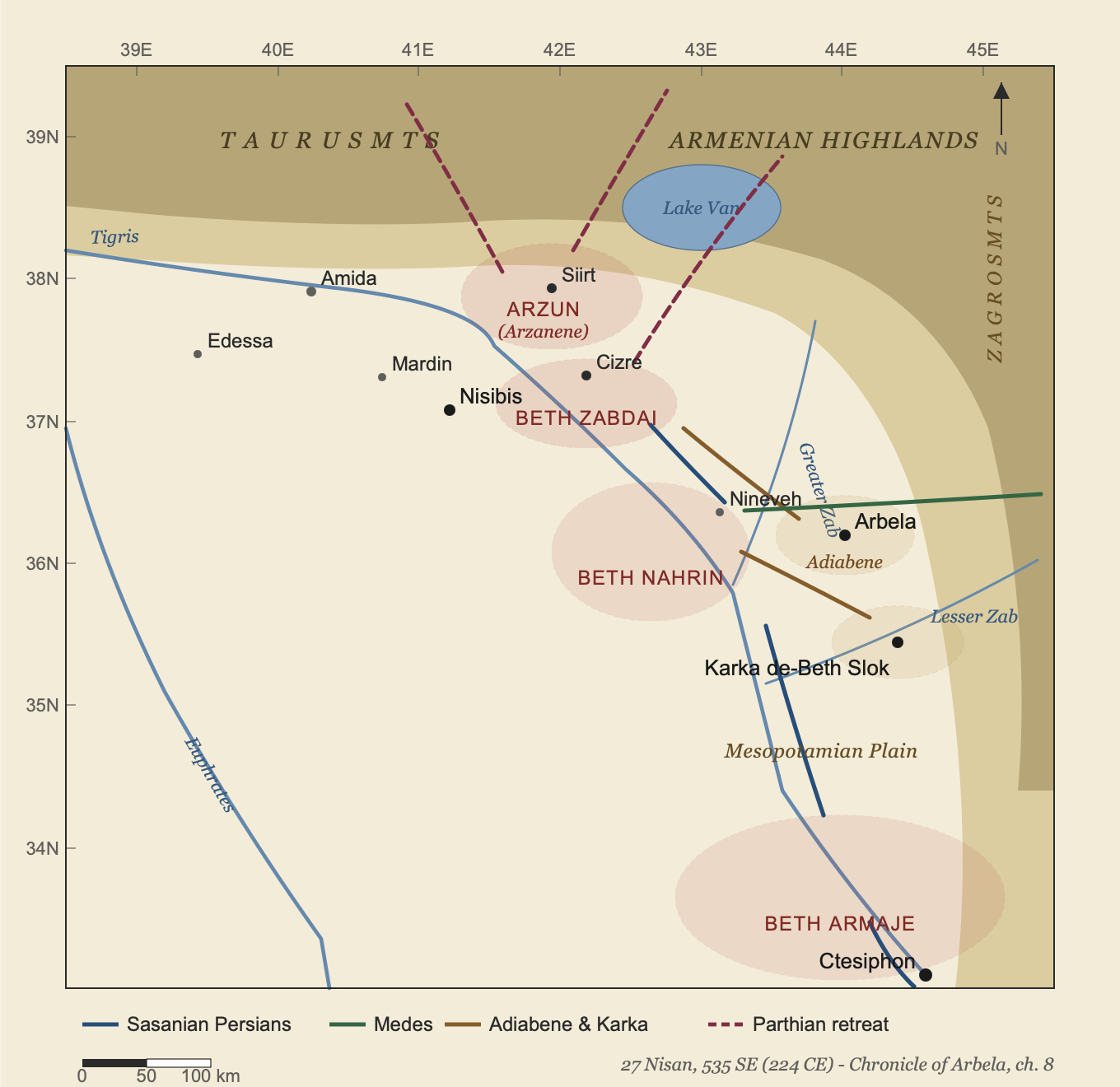
On the twenty-seventh of Nisan in the year 535 of the Seleucid Era — a Wednesday in late April 224 CE — a coordinated army marched into the district the Syriac chroniclers called Arzun, the region we now know as the province of Siirt. Persians and Medes had allied with the local kingdoms of Adiabene and Karka de-Beth Slok, and they were closing on four Parthian-held territories at once. Within a year all four had fallen, and the last Arsacid forces vanished into the highlands of the southeastern Taurus.
This is not the version of Ardashir I’s rise you read in the textbooks. The famous story is Hormozdgan — the pitched battle in the plains of Khuzestan where Artabanus IV died at the hands of the first Sasanian king. But the terminal front of the Parthian collapse was not in the Persian heartland. It was in the mountains and valleys of what is today northern Kurdistan.
A single, difficult source
Almost everything we know about this northern collapse comes from one work: the Chronicle of Arbela, attributed to a certain Mšiḥa-Zkha, a monk of Adiabene who probably wrote in the mid-sixth century [1]. The chronicle presents itself as a history of the bishops of Arbela (modern Erbil), stretching from apostolic times through the Sasanian era.
The text is controversial. Alphonse Mingana published the sole known manuscript in 1907 [2]; Eduard Sachau produced a German translation in 1915 [3]; Peter Kawerau issued the standard critical edition in 1985 [4]. Between Mingana’s and Kawerau’s editions, Jean-Maurice Fiey mounted an extraordinary attack in 1967, arguing that Mingana himself had fabricated the entire chronicle [5]. Sebastian Brock and later scholars substantially weakened Fiey’s radical position [6], but the questions have not entirely vanished. The current consensus is that the chronicle preserves genuine historical material, but that individual claims must be handled with care.
For the Parthian period specifically, the chronicle names a single source: Habel the Teacher (Ḥabel malfānā), an otherwise unknown Adiabenian writer often described as the only Syriac author with precise knowledge of Arsacid history [7]. Habel is either an authentic and extraordinary lost historian, or he is the weakest link in the chronicle’s chain of transmission. There is no way to be certain.
With that caveat firmly in place, the material is worth taking seriously — because on the geography of the northern Parthian frontier, the chronicle is remarkably specific.
The first front: Arzun and Beth Zabdai
The critical passage falls in Chapter 8, treating the tenure of Bishop Ḥairan of Arbela. In translation from Kawerau’s German edition it reads:
The chronicle describes how the Persians and Medes allied with Šahrat, the king of Adiabene, and Domitiana of Karka de-Beth Slok, and in spring attacked the weakened Parthians. The first assault struck Beth Nahrin, Beth Armaje, Beth Zabdai, and Arzun; within a year all these lands were conquered, and the Parthians fled together into the high mountains.
The date is given with unusual precision: 27 Nisan, a Wednesday, in the year 535 of the Seleucid Era — corresponding to April 224 CE, only weeks after Ardashir’s victory at Hormozdgan. And the phrase used for the ended empire — “the sons of Aršaq the Mighty” — shows that the chronicler names the Arsacid dynasty deliberately.
The geography is what makes this passage historically explosive. Kawerau’s editorial notes identify Arzun explicitly as Arzanene — the district encompassing what is today Siirt and its immediate hinterland — and Beth Zabdai as Bezabde, corresponding to modern Cizre on the Tigris [9]. Beth Nahrin is northern Mesopotamia broadly, and Beth Armaje is the Aramaean lowland further south around Ctesiphon.
The chronicler thus positions the Siirt–Cizre corridor as the first target of the Sasanian northern campaign. That is a strong claim, and it carries an unavoidable implication: there must have been something Parthian there worth conquering. Garrisons, loyal client dynasts, or Parthian settlement — the source does not specify — but a peace or an empty borderland is not conquered.
Equally striking is the retreat direction. The Parthians do not withdraw eastward toward the Iranian plateau. They flee upward, into the high mountains of the Taurus and the Armenian highlands. This is the behavior of forces already at the edge of familiar terrain, using the mountains they know as a last refuge.
Parthians in the Qardu Mountains
The chronicle’s northern geography is not confined to Chapter 8. Chapter 3, treating the mid-second century, contains a striking episode that places Parthian military operations directly in the mountains southwest of Lake Van.
Raqbakt, the imperial governor of Adiabene, receives a secret Christian baptism — the story is hagiographical in its framing. But during a meal, a courier arrives from Ctesiphon with an urgent message: the Great King Vologeses summons him to suppress a rebellion that has “fallen upon the land of the Qardu mountains” and plundered many cities [10].
The response is a military expedition commanded by a general named Aršak. His orders are unusual: gather twenty thousand infantry. The chronicler explains why, and Kawerau’s editorial notes underline the point: cavalry could not operate in the mountains [11].
Read that carefully. This is a Parthian force fighting the wrong way — not with the horse archery that made their military reputation, but with foot soldiers, because the terrain demanded it. The rebel leader, a certain Kizo, defeats Raqbakt in the initial engagement, and the rebels go on to seize “all the cities of Aršaq” — the Arsacid strongholds in the region — before turning on another people who had crossed “the sea” (the Caspian, in Kawerau’s identification) [12].
Parthian imperial authority extended into the Qardu mountains to the point where the Great King in Ctesiphon deploys named commanders and multi-division infantry armies there, and where “the cities of Aršaq” are numerous enough to be lost in bulk. The Parthians of this chronicle are not visitors to the northern highlands. They are an occupying and administering power that has to send its armies there.
What survives, and what it implies
The two passages complement each other. Chapter 3 shows Parthian imperial presence in the Kurdish mountains during the high Arsacid period. Chapter 8 shows the same region as the first casualty of Sasanian conquest a generation later. Together they place Parthian authority — administrative, military, and to some degree demographic — in the Siirt–Cizre–Qardu triangle across the whole span of the second and early third centuries.
The chronicle shows a sustained Parthian presence in what would later become the Kurdish heartland. That is a modest but non-trivial finding, and it is more than the standard narrative — dominated by Hormozdgan and the fall of Ctesiphon — usually acknowledges.
The last stand of the Parthians, if we believe the chronicle, was not at Ctesiphon or in the plains of Fars. It was in the mountains above Siirt and Cizre, in the spring of the year 224.
Sources
- Attributed to Mšiḥa-Zkha (Christus vicit), a monk or presbyter of Adiabene, probable date of composition mid-sixth century CE. Attribution and dating are debated. See Encyclopaedia Iranica, s.v. “Arbela, Chronicle of.”
- Alphonse Mingana (ed.), Sources syriaques, vol. I: Mšiḥa-Zkha, Bar Penkayē. Leipzig / Mossoul: Otto Harrassowitz & Imprimerie des Pères Dominicains, 1907–1908.
- Eduard Sachau, Die Chronik von Arbela: Ein Beitrag zur Kenntnis des ältesten Christentums im Orient. Abhandlungen der Preussischen Akademie der Wissenschaften, philosophisch-historische Klasse, Nr. 6. Berlin, 1915.
- Peter Kawerau (trans.), Die Chronik von Arbela. Corpus Scriptorum Christianorum Orientalium (CSCO) 468, Scriptores Syri 200. Louvain: Peeters, 1985. Syriac text in CSCO 467, Scriptores Syri 199.
- Jean-Maurice Fiey, “Auteur et date de la Chronique d’Arbèles,” L’Orient Syrien 12 (1967), pp. 265–302.
- See the entry on the Chronicle of Arbela in the Gorgias Encyclopedic Dictionary of the Syriac Heritage (GEDSH), Piscataway: Gorgias Press, 2011.
- On Habel and the chronicle’s Parthian-period sources, see Kawerau (ref. 4), introduction, and Encyclopaedia Iranica, s.v. “Arbela, Chronicle of.”
- Chronicle of Arbela, Chapter 8, episcopate of Ḥairan of Arbela. Translated from Kawerau (ref. 4).
- Kawerau (ref. 4), editorial notes to Chapter 8, identifying Arzun = Arzanene and Beth Zabdai = Bezabde/Cizre.
- Chronicle of Arbela, Chapter 3, on Raqbakt and the revolt in the Qardu mountains. Kawerau translation (ref. 4).
- Kawerau (ref. 4), editorial notes to Chapter 3, on infantry for mountain warfare and the name Aršak (Arsakes / Armenian Արշակ).
- Kawerau (ref. 4), editorial notes to Chapter 3, identifying “the sea” as the Caspian throughout the chronicle.


